Estuary Gateway
Samuel Kamara
Estuary Gateway is a strategic architectural intervention sited on an existing concrete jetty along the River Thames. It directly responds to contemporary "social disconnection" by reviving vital local maritime and cultural connections.
The project addresses two critical recent closures: the Tilbury Bridge ‘Walkway of Memories’ art installation and the Gravesend-to-Tilbury ferry service, which historically linked Kent and Essex. By establishing a new ferry terminal and museum, the design restores an environmentally sustainable commuter route while creating a permanent memorial to the Windrush Generation who arrived at Tilbury Port from the Caribbean in 1948.
The Spatial Journey Mirroring the historic voyage of the Windrush, visitors must arrive at the gateway by boat. The architecture is organized into three distinct, atmospheric halls that guide visitors through a narrative of arrival and departure:
The Ferry Terminal: A light-filled landing zone featuring a glass barrel roof.
The Arrival Lounge: A contemplative space with concrete seating beneath a ceiling filled with well-travelled artefacts.
The Museum: The emotional core of the project, housing oral histories and a 1:1 scale Jamaican Veranda house.
Transitions between these spaces are punctuated by pre-tensioned stone gateways that mimic the English Baroque façade of the neighbouring Tilbury Fort’s Watergate. Ultimately, Estuary Gateway utilizes the power of storytelling and spatial connection to ensure Tilbury’s rich legacy as a historic place of arrival is preserved before its stories are lost entirely.
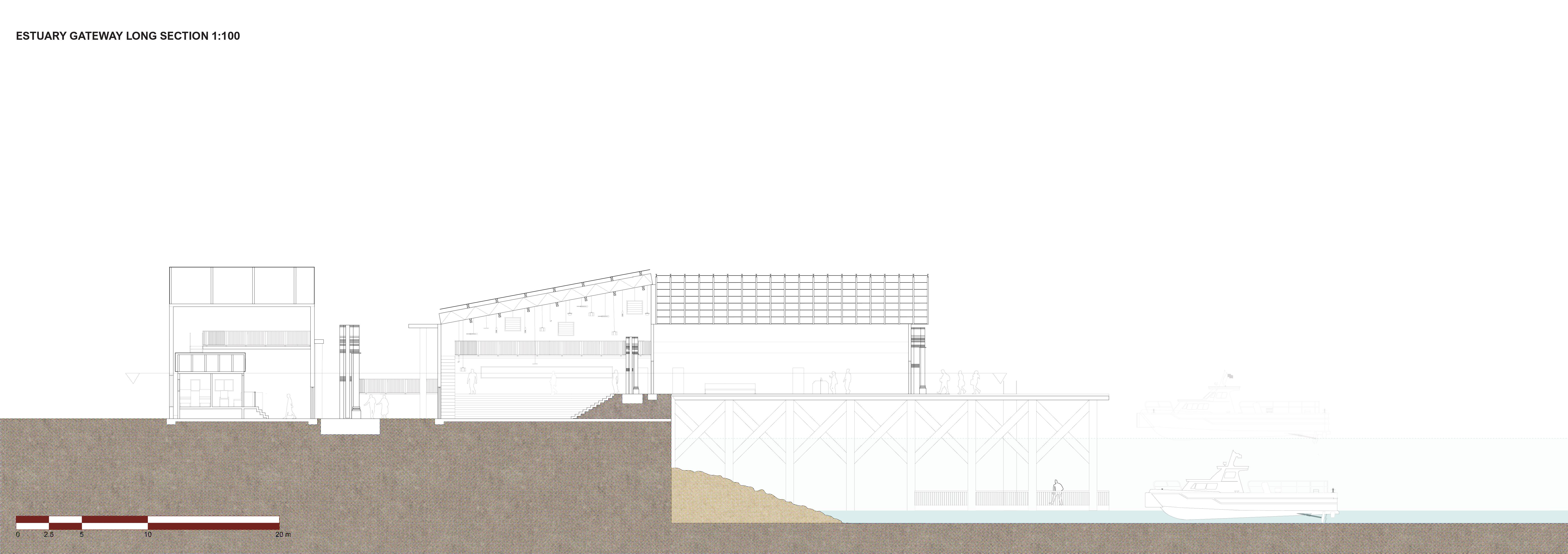
Estuary Gateway: long section