The Living Grotto
Caroline Mukane
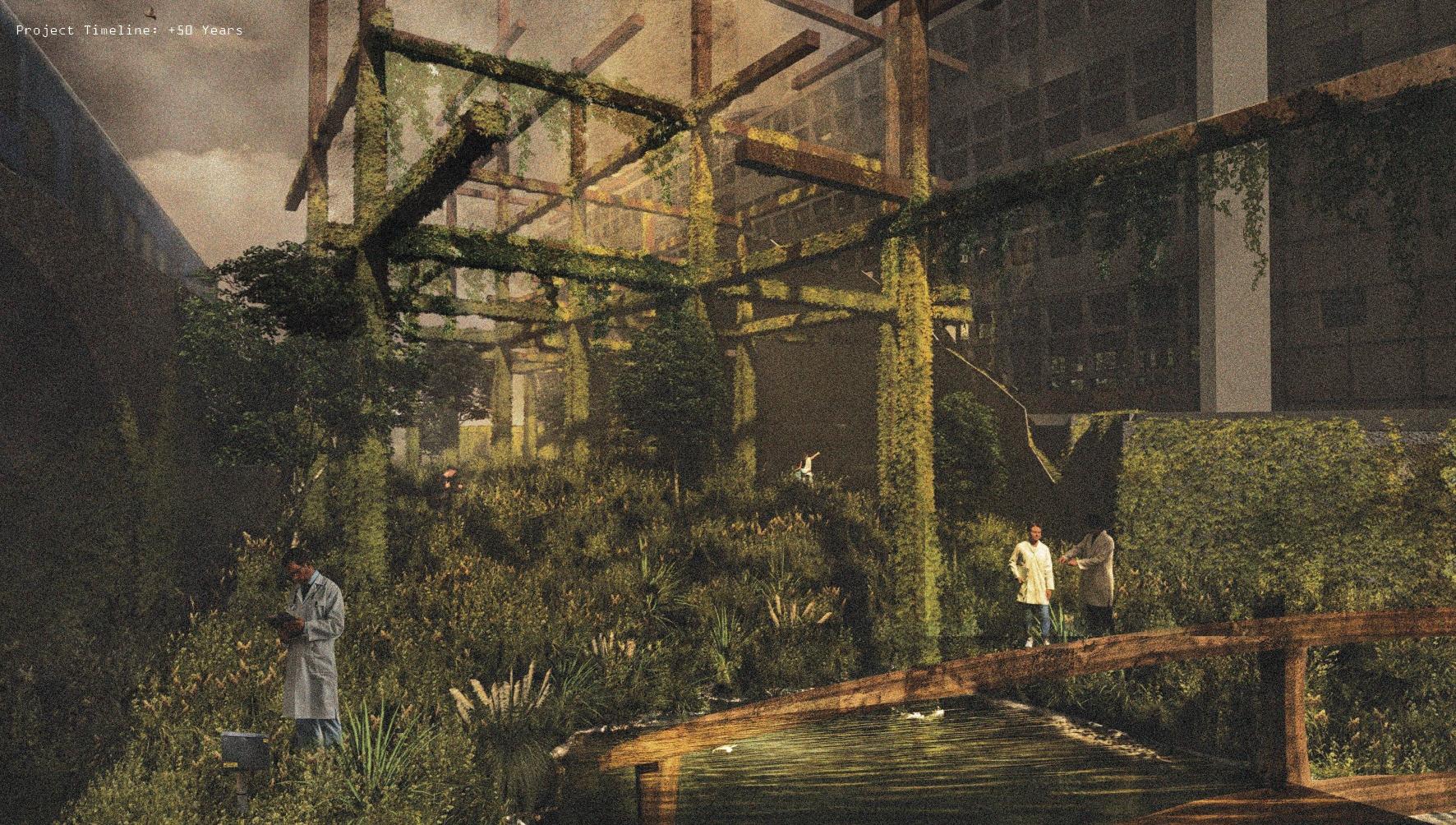
The Living Grotto transforms the Proposition Building in Bethnal Green into a living research institution inspired by the Natural History Museum’s Living Laboratory. Operating across habitat, landscape, and urban scales, the project explores how architecture can evolve into a regenerative ecological system in response to climate change. Influenced by J.G. Ballard’s The Drowned World, where nature overwhelms the city, the proposal reframes this idea by asking whether urban nature reclaiming architecture could support future environmental resilience rather than represent collapse.
At the centre of the project is a large vertical grotto that forms the main public route through the building. As visitors move upward, the space expands into an immersive environment where vegetation grows freely across surfaces, creating habitats for birds, insects, and other urban species. Rather than being controlled, the ecosystem continuously changes over time, allowing human and non-human life to coexist within a multispecies environment.
The project integrates environmental sensor systems that monitor biodiversity, air quality, temperature, and ecological change in real time. Wet laboratories and open research spaces study water, soil, plants, and microbial life, making the building both the subject and tool of research. Existing floor plates are removed through diamond cutting, with extracted concrete and glass crushed and reused to reinforce the grotto structure, creating a circular material system.
Through ecological growth, material reuse, and public participation, The Living Grotto proposes a new model for regenerative urban architecture where nature, technology, and human activity evolve together.
I am an architecture student passionate about designing spaces that reconnect people with nature. My work explores ecological systems, material reuse, and immersive spatial experiences, investigating how architecture can adapt and evolve in response to environmental change. Through speculative and research-driven design, I am interested in creating regenerative environments that support both human and non-human life while challenging conventional relationships between architecture, landscape, and technology.